Frequently Asked Questions
The most-asked questions about cnidarians.
What exactly are cnidarians and why should I care?
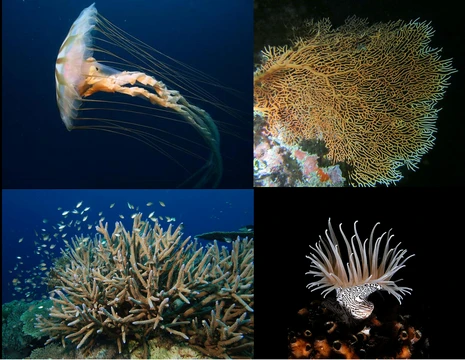
Cnidarians are a phylum of mostly aquatic animals that includes jellyfish, corals, sea anemones, and hydras, all united by radial symmetry and a specialized stinging cell called a cnidocyte. They've been stinging, drifting, and building reefs for over 500 million years, making them one of the oldest surviving animal lineages.
What are the two body forms and how do they differ?
Most cnidarians cycle between a stationary, tube-like polyp and a free-floating, umbrella-shaped medusa, though some lineages (like all Anthozoa) only ever live as polyps. The polyp typically handles reproduction and anchoring, while the medusa is built for swimming and active predation.
What makes cnidocytes so special?
Cnidocytes are explosive cellular weapons: each one houses a coiled, barbed thread (the nematocyst) that can fire in under half a millisecond to inject venom into prey or predators. This single cell type is the defining trait of the entire phylum and the reason a casual beach touch can turn painful fast.
How many major classes are there and how do I tell them apart?
There are four recognized classes: Anthozoa (corals and anemones, polyp-only), Scyphozoa (the 'true' jellyfish with broad bells), Cubozoa (box jellies with a cubic bell and highly venomous tentacles), and Hydrozoa (hydras, siphonophores, and many smaller jellyfish). A quick way to sort them is to ask whether the animal has a medusa stage and, if so, whether the bell is round, box-shaped, or small and translucent.
Where can I actually find cnidarians in the wild?
They occupy nearly every water habitat on Earth, from the sunlit shallows of tropical reefs to the crushing pressures of the deep sea, and even the slow-moving pools of a freshwater creek where hydras cling to rocks. A single tide pool can host anemones, hydroids, and tiny jellyfish all within arm's reach.
Which cnidarian is the most dangerous to humans?
The Australian box jellyfish, Chironex fleckeri, is generally regarded as the most lethal; its venom can disrupt cardiac rhythm and cause death within minutes if untreated. Even a brief brush with its tentacles can produce severe systemic symptoms, which is why reef swimmers in northern Australia wear full-body stinger suits.
How do reef-building corals fit into the bigger picture?
Corals are colonial polyps in the class Anthozoa that secrete calcium-carbonate skeletons, and their partnership with photosynthetic dinoflagellates (zooxanthellae) powers entire reef ecosystems that shelter roughly a quarter of all marine species. Coral bleaching—driven by sustained heat stress—has become one of the most visible indicators of ocean warming.
Who are some standout researchers or figures in cnidarian science?
Pioneers like Hans Spemann used sea-urchin and early invertebrate embryos to lay groundwork for developmental biology, while modern coral ecologists such as Jeremy Jackson and oceanographers tracking jellyfish blooms have kept the phylum in the public spotlight. On the fan side, long-running citizen-science jellyfish monitoring programs (e.g., JelliesWatch) have made amateur observation a real part of the field.
Where should a total newcomer start if they want to get into cnidarians?
Begin with the polyp-to-medusa life cycle and the anatomy of a single cnidocyte; once those two ideas click, the four classes and their representative species fall into place naturally. A short documentary on coral reef symbiosis or a hands-on look at a hydra under a magnifying glass are both great low-commitment entry points.
What's the single most 'mind-blown' fact about cnidarians?
The jellyfish Turritopsis dohrnii can, under stress, transdifferentiate its adult medusa cells back into a juvenile polyp and restart its life cycle, effectively evading senescence and earning the informal label 'immortal jellyfish.' No other known animal can reverse its developmental trajectory this completely, which is why it remains a favorite in both lab studies and fan discussions.