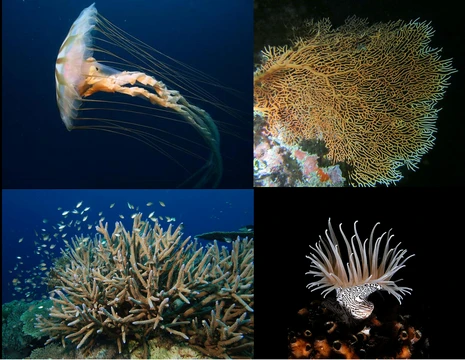
Anthozoa
Flower-like marine animals that build and enhance reef systems.

Anthozoa is one of the three subphyla of Cnidaria, comprising sessile marine and brackish-water invertebrates such as sea anemones, stony corals, soft corals, and sea pens. They are known as 'flower animals' due to the floral appearance of their perennial polyp stage, and they are the largest taxon of cnidarians, with over six thousand described species.
- subphylum
- Anthozoa
- phylum
- Cnidaria
- classes
- Hexacorallia, Octocorallia, Rugosa †, Tabulata †
- habitat
- Marine and brackish water
- known_for
- Reef-building, cnidocytes, lack of medusa stage
- diversity
- Over 6,000 described species
Lore & Background
Anthozoans live exclusively in marine and brackish water, with almost all adults attached to the seabed while their larvae exist as zooplankton. The basic adult unit is the polyp, a cylindrical column topped by a disc with a central mouth surrounded by tentacles. Sea anemones are mostly solitary, but most corals are colonial, formed by budding of new polyps from an original individual. Colonies of stony corals are strengthened mainly by aragonite and can take massive, plate-like, bushy, or leafy forms. Members of Anthozoa possess cnidocytes, shared with other cnidarians. They are carnivores, catching prey with tentacles, and many supplement energy needs via photosynthetic algae living in their tissues. Unlike other cnidarians, anthozoans lack a medusa stage; they release sperm and egg cells into the water, and after fertilization, planula larvae settle on the seabed and metamorphose into polyps. Some also reproduce asexually through budding or fragmentation. The two extant classes are Hexacorallia (six-fold symmetry) and Octocorallia (eight-fold symmetry). Genetic studies have shown that Anthozoa is monophyletic, with its ancestor likely a solitary polyp with bilateral symmetry, lacking a skeleton and photosymbiosis, present in the Tonian period. The taxonomy is continuously updated based on molecular biology.
Reader's Guide
Anthozoa holds significant ecological and evolutionary importance as the largest cnidarian taxon, encompassing over six thousand species that build and enhance reef systems. Their ability to form massive colonies of stony corals, strengthened by aragonite, creates critical marine habitats. The subphylum's lack of a medusa stage distinguishes it from other cnidarians, and its reproductive strategies include both sexual (planula larvae) and asexual (budding, fragmentation) methods. Phylogenetic studies have clarified that Anthozoa is monophyletic, with Hexacorallia and Octocorallia as sister clades, and have traced the independent evolution of key traits such as colonial growth, calcified elements, and photosymbiosis across different lineages. The deep-water coral diversity exceeds that of shallow reefs, indicating a complex evolutionary history of habitat shifts. The ongoing revision of anthozoan taxonomy, based on molecular phylogenetics, continues to refine understanding of their relationships and classification.
Did You Know?
- The name 'Anthozoa' comes from Greek words meaning 'flower animals'.
- Anthozoans do not have a medusa stage in their development.
- More species of coral live in deep water than in shallow water.
- The reconstructed ancestor of Anthozoa was a solitary polyp with bilateral symmetry.
Frequently Asked Questions
Who is Anthozoa?
Anthozoa is the largest of the three cnidarian subphyla, encompassing more than six thousand described species of sessile marine and brackish-water invertebrates. The name translates to 'flower animals,' a nod to the petal-like appearance of their long-lived polyp form.
What are Anthozoa's powers/abilities?
Members of this group deploy specialized stinging cells called cnidocytes to capture prey and defend themselves. Many species also construct calcium carbonate skeletons, forming the structural foundation of tropical reef ecosystems.
What classes does Anthozoa include?
The subphylum is divided into four classes: Hexacorallia (sea anemones and stony corals), Octocorallia (soft corals and sea pens), and two now-extinct groups, Rugosa and Tabulata. The living classes dominate modern coral reefs and deep-sea environments alike.
Why is Anthozoa important?
Anthozoans are the primary architects of coral reefs, which shelter an estimated quarter of all marine species. Their cnidocytes also serve as a model system for studying cell-mediated immunity and stinging mechanisms in biology.
How does Anthozoa's story end?
Two of its four classes—Rugosa and Tabulata—went extinct in the geological past, with the last tabulate corals disappearing around the Permian-Triassic boundary. The remaining living classes, however, continue to thrive in oceans worldwide, making Anthozoa an ongoing rather than concluded chapter in cnidarian history.
More in Cnidarians 1-18
Spotted an error? Know more?
This is a living reference — every entry is fact-audited, and reader corrections feed straight into our audit queue. Suggest an edit · See this site's audit record