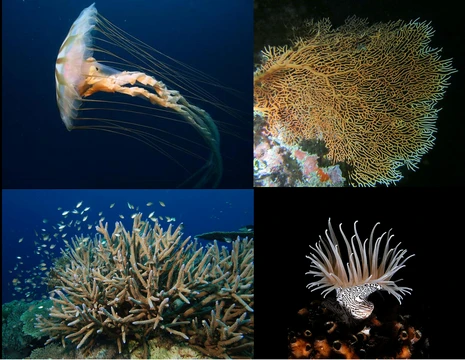
Box jellyfish
Box jellyfish are venomous cnidarians with cube-shaped bells and complex eyes.

Calistemon · CC BY-SA 4.0
Box jellyfish (class Cubozoa) are cnidarian animals distinguished by their box-like (cube-shaped) body. Some species produce potent venom delivered by contact with their tentacles, and stings from species including Chironex fleckeri, Carukia barnesi, Malo kingi, and a few others are extremely painful and often fatal to humans. Other species, such as Carybdea murrayana, produce a mild sting that is generally not notably painful.
- Maximum tentacle length
- 4.5 m (15 ft) or longer
Lore & Background
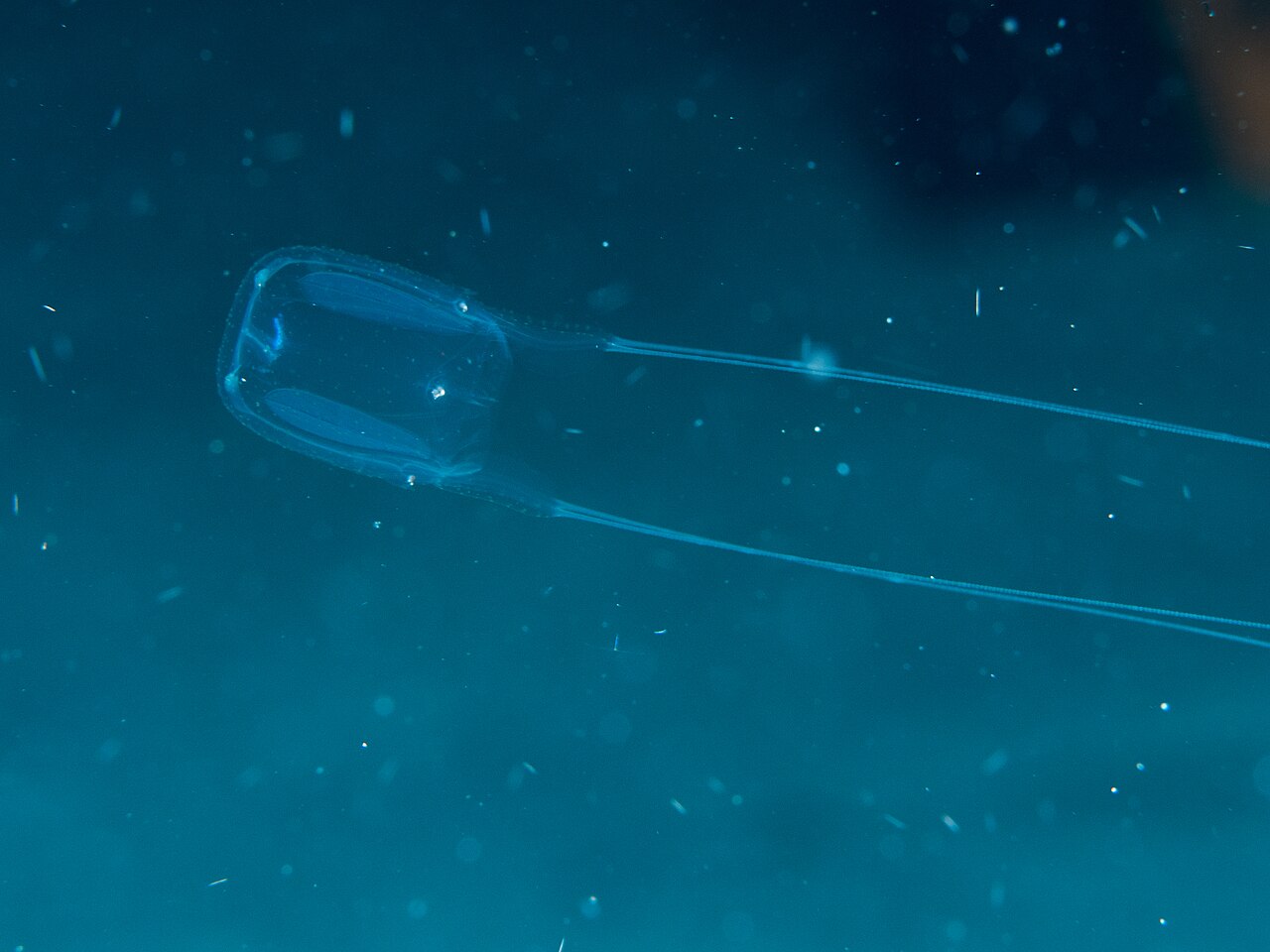
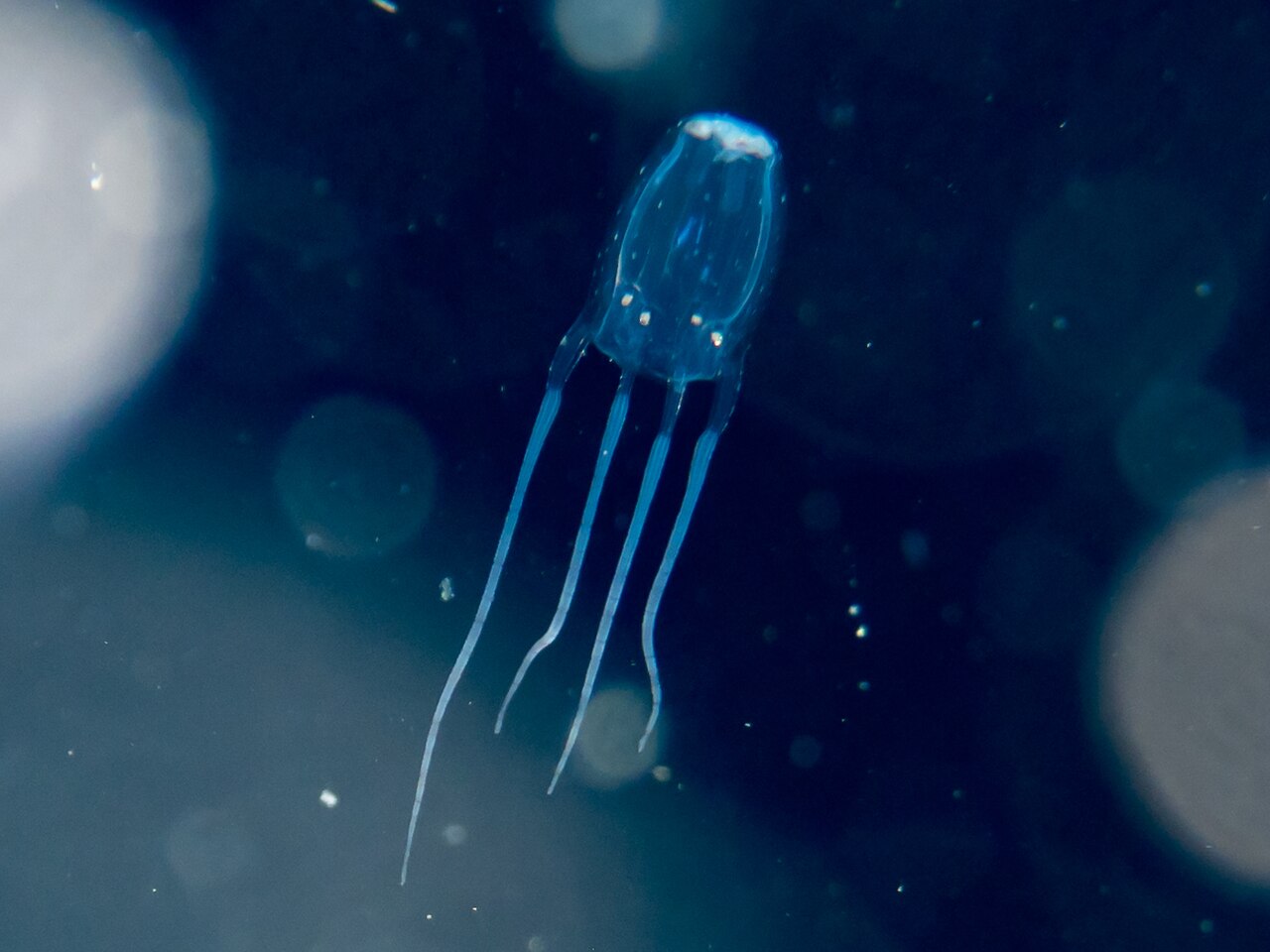
Box jellyfish were historically classified as an order of Scyphozoa until 1973, when they were placed in their own class due to their unique biological cycle (lack of strobilation) and morphology. Their medusa form has a squarish, box-like bell, from each of the four lower corners of which hangs a short pedalium bearing one or more long, hollow tentacles. The rim of the bell is folded inward to form a velarium, which restricts the bell's aperture and creates a powerful jet when the bell pulsates, allowing speeds up to 1.5 metres per second. Their nervous system is more developed than that of many other jellyfish. They possess a ring nerve at the base of the bell and true eyes with retinas, corneas, and lenses. Each of the four rhopalia contains two image-forming lens eyes, two pit eyes, and two slit eyes, for a total of 24 eyes. The rhopalia also feature a statolith that keeps the eyes oriented vertically regardless of the bell's orientation. Box jellyfish display complex, visually-guided behaviors such as obstacle avoidance and fast directional swimming.
Reader's Guide
Box jellyfish are significant for their potent venom, which can be fatal to humans, and for their advanced sensory and nervous systems relative to other jellyfish. Their distribution spans tropical and subtropical oceans between 42° N and 42° S, including the Atlantic, Pacific, and Indian Oceans, with species found as far north as California and Japan and as far south as South Africa and New Zealand. Detection of cubozoans is difficult due to their translucent bodies, two life stages (medusa and polyp), and size variability. Methods such as visual observation, nets, light attraction, drones, and environmental DNA (eDNA) have been used to monitor populations. The eDNA technique involves filtering water samples to extract genetic material and matching sequences to identify presence. Their legacy includes ongoing research into venom, ecology, and detection methods to mitigate risks to coastal human activities.
Did You Know?
- Box jellyfish have 24 eyes: six on each of their four rhopalia, including two image-forming lens eyes per rhopalium.
- Some species, such as Chironex fleckeri, produce venom that is extremely painful and often fatal to humans.
- Box jellyfish can move at speeds up to 1.5 metres per second, faster than many other jellyfish.
Architecture of the Bell and Its Internal Machinery
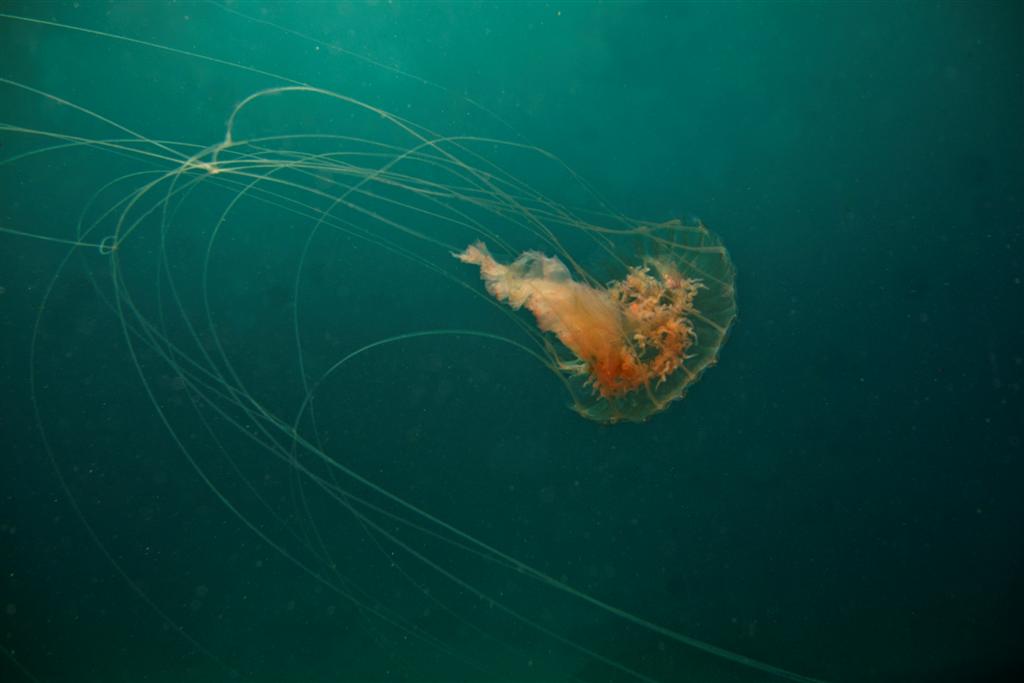
The medusa of a box jellyfish is defined by its distinctive cube-shaped bell, a geometry that gives the entire class its name. From each of the four lower corners dangles a short stalk called a pedalium, from which long, hollow tentacles extend. The bell's rim curls inward to form a velarium; this narrowing of the aperture means every pulsation expels a concentrated jet of water, propelling the animal at speeds reaching 1.5 metres per second—far faster than most other jellyfish. Beneath the bell, a mobile trunk-like appendage known as the manubrium carries the mouth at its tip. The interior cavity is partitioned by four equally spaced septa into a central stomach and four gastric pockets, with eight gonads arranged in pairs along those septa. Septal margins carry dense bundles of gastric filaments housing nematocysts and digestive glands to help subdue prey, while septal funnels open onto the oral surface to regulate fluid flow. Size ranges dramatically: the Irukandji is no larger than a thumbnail, while larger species can span 20 centimetres per side, stretch tentacles to three metres, and weigh up to two kilograms. Each of the roughly fifteen tentacles per corner carries around half a million cnidocytes, each packed with a harpoon-shaped nematocyst ready to deliver venom.
Twenty-Four Eyes and a Nerve Ring That Coordinates Vision
Unlike most jellyfish, which rely on simple pigment-cup ocelli, box jellyfish possess true eyes complete with retinas, corneas, and lenses—a singular achievement in the cnidarian world. These eyes sit in clusters at the tips of four sensory structures called rhopalia, each linked to a ring nerve circling the bell's base that coordinates pulsing. Each rhopalium bears six eyes: two image-forming lens eyes, two pit eyes likely serving as light meters, and two slit eyes detecting vertical movement. In Tripedalia cystophora, the upper lens eye gazes straight up with a field of view matching Snell's window and is used to navigate toward mangrove lagoon edges by reading the tree canopy's direction. The lower lens eye handles object avoidance, and the minimum visual angle for avoided obstacles matches the half-widths of their receptive fields. A heavy crystal-like statolith in each rhopalium keeps the eyes oriented vertically regardless of bell tilt. The density and arrangement of rhopalial nerve cells suggest visual processing occurs at least partly within the rhopalia themselves. Together these features support complex, visually guided behaviours—obstacle avoidance and fast directional swimming—earning box jellyfish the description of active, fish-like behaviour.
Venom, Nematocysts, and the Lethal Small
Box jellyfish deliver their venom through contact with their tentacles, and the consequences for humans range from severe pain to death. Species such as Chironex fleckeri, Carukia barnesi, and Malo kingi produce stings that are extremely painful and frequently fatal. Others, like Carybdea murrayana, inflict a painful sting but are not known to kill. The weapon behind every sting is the nematocyst: a harpoon-shaped microscopic mechanism housed inside a cnidocyte that injects venom into the victim. Many different kinds of nematocysts have been identified across cubozoan species, suggesting a diverse venom arsenal. The sheer quantity is staggering—each tentacle carries roughly half a million cnidocytes, and a single bell corner may bear around fifteen tentacles. What makes the group especially alarming is that size does not predict danger. The Irukandji, a box jellyfish no bigger than a thumbnail, is fully lethal to humans, while the much larger Chironex species are equally deadly. This means that even a brief, seemingly innocuous brush with a tiny, translucent medusa in tropical waters can deliver a potentially fatal dose of venom, making box jellyfish among the most dangerous marine animals on Earth.
Classification, Global Range, and the Pace of Discovery
For much of the nineteenth and early twentieth centuries, cubozoans were lumped together as an order within Scyphozoa. It was not until 1973 that they were elevated to their own class, Cubozoa, in recognition of a unique biological cycle—specifically the absence of strobilation—and their distinctive morphology. Their geographic range spans tropical and subtropical waters between 42° north and 42° south latitude, stretching from the Atlantic to the east Pacific. Species have been recorded as far north as California, the Mediterranean, and Japan, and as far south as South Africa and New Zealand. In Hawaiian waters, three Carybdea species are known. Box jellyfish tend to favour near-shore environments—mangroves, coral reefs, kelp forests, and sandy beaches.
Gallery
Frequently Asked Questions
What is Box jellyfish?
Box jellyfish refers to the class Cubozoa, a group of stinging marine animals whose body plan takes the shape of a hollow cube rather than the round bell you'd see in a typical jellyfish. They sit within the phylum Cnidaria and are noted for having some of the most sophisticated visual systems in the animal kingdom.
What are Box jellyfish's special abilities?
Members of this class carry dense clusters of stinging cells along their trailing tentacles, and in several species the venom they deliver can cause severe pain, cardiac failure, or death in humans within minutes. They also possess up to twenty four-lensed eyes arranged around the bell, giving them a level of spatial awareness far beyond most other cnidarians.
How long can Box jellyfish tentacles grow?
In the largest species, individual tentacles can stretch to roughly 4.5 metres (about 15 feet) or even longer, making them one of the most physically imposing cnidarians found in tropical coastal waters.
Are all Box jellyfish species deadly?
No—danger varies widely across the class. While species like Chironex fleckeri and Carukia barnesi deliver stings that are extremely painful and frequently lethal, others such as Carybdea murrayana produce a relatively mild sting that most people barely notice.
Why is Box jellyfish a standout entry in the Cnidarians list?
They occupy slot 1-18 in the fan-encyclopedia numbering and stand out because they combine a geometrically distinct body shape, advanced compound eyes, and in some cases the most potent marine venoms known to science, all within a single cnidarian class.
More in Cnidarians 1-18
Spotted an error? Know more?
This is a living reference — every entry is fact-audited, and reader corrections feed straight into our audit queue. Suggest an edit · See this site's audit record