Praya dubia
A deep-sea colonial organism reaching lengths up to 50 meters.

Alzinous · CC BY-SA 4.0
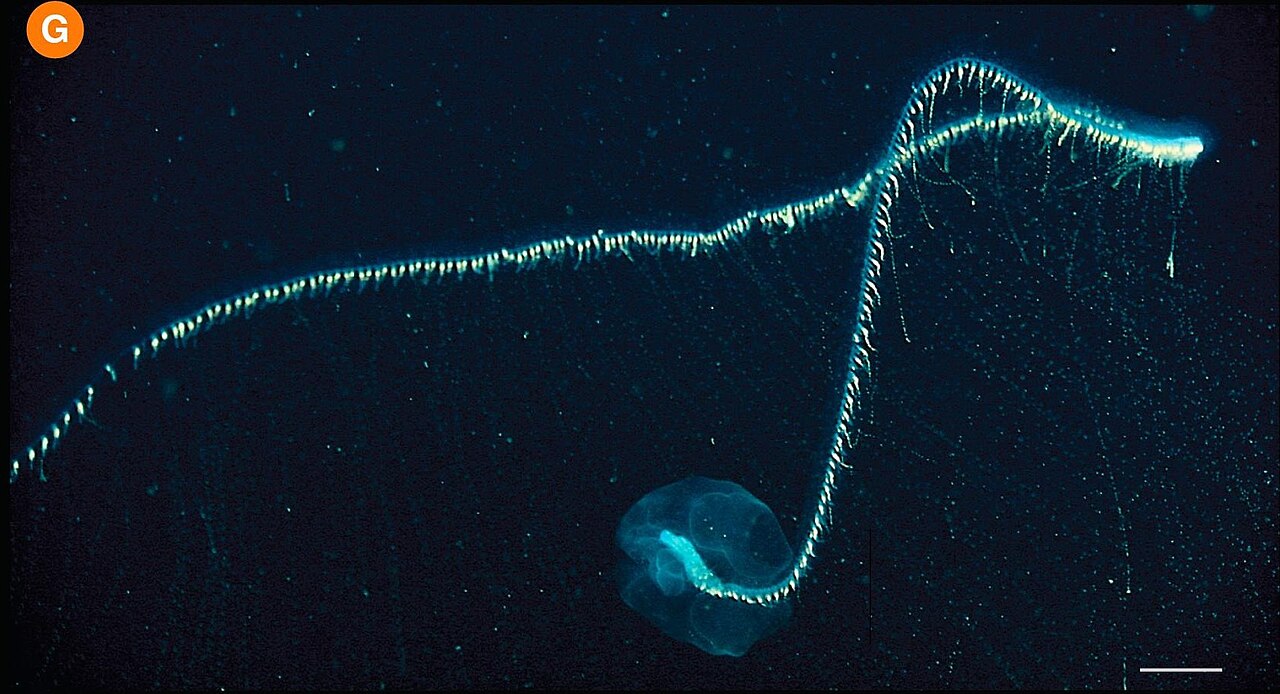
It has been observed off coasts worldwide, from Iceland in the North Atlantic to Chile in the South Pacific. As a member of the order Siphonophorae within the class Hydrozoa, it is notable for its extreme length, reaching up to 50 meters, making it one of the longest sea organisms, rivaling the blue whale in length though far thinner.
- class
- Hydrozoa
- order
- Siphonophorae
- known_for
- Second-longest sea organism; bioluminescent attraction; toxic sting
Lore & Background
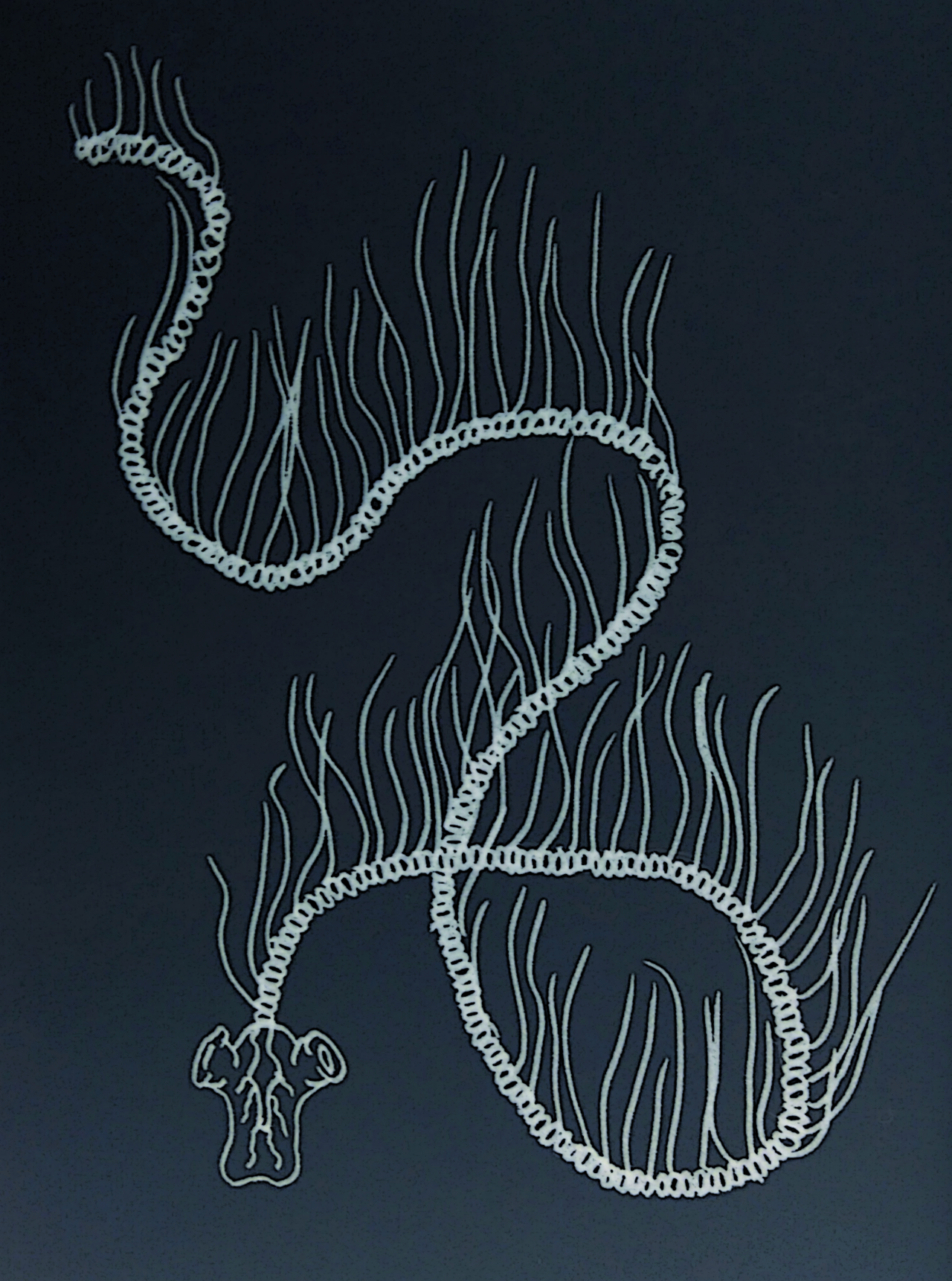
Praya dubia is not a single multicellular organism but a colony of specialized zooids that cannot survive independently. These zooids arrange themselves along a long, usually whitish and transparent stalk called a physonect colony. Nectophores, powerful medusae that pulsate in coordination, form the nectosome and propel the colony. Beneath this, the siphosome extends to the far end, containing repeating patterns of specialized zooids, including tentacles for catching food, palpons (dactylozooids) with excretory and possibly defensive functions, and transparent bracts (hydrophyllia) that cover and force other zooids to contract in danger.
Reader's Guide
Praya dubia's significance lies in its unique colonial biology and its role as a deep-sea predator. Its hydrostatic skeleton, held together by water pressure above 46 MPa, causes it to burst when brought to the surface, explaining why its remains were long mistaken for gelatinous blobs until the 19th century. The species actively swims, attracts prey with bright blue bioluminescence, and deploys a curtain of tentacles armed with nematocysts that deliver a powerful, toxic sting. Its diet includes gelatinous sea life, small crustaceans, and possibly small fish and larvae, and it has no known predators. A specimen was featured in Episode 2 of the television series Blue Planet II.
Did You Know?
- Praya dubia can reach 50 meters in length, rivaling the blue whale but as thin as a broomstick.
- It is a colony of tiny zooids, each evolved for a specific function, that cannot survive alone.
- The species bursts when brought to the surface due to its hydrostatic skeleton requiring pressure above 46 MPa.
- It attracts prey with bright blue bioluminescent light and has no known predators.
Gallery
Frequently Asked Questions
What is Praya dubia?
Praya dubia is a colonial deep-sea creature belonging to the siphonophore group within the hydrozoan class. Rather than being a single animal, it is a colony of specialized polyps that function together as one elongated organism.
What makes Praya dubia so remarkable?
Beyond its record-breaking length, it produces bioluminescent light to lure prey in the pitch-dark deep sea and wields a toxic sting to subdue whatever it catches. These traits make it one of the most striking predators in the twilight and midnight zones.
Is Praya dubia a single organism or a colony?
It is a colonial organism, meaning thousands of genetically identical polyps (zooids) cooperate as a single functional unit. Each zooid handles a specific task—drifting, stinging, or digesting—while the colony moves and feeds as one.
More in Cnidarians 1-18
Spotted an error? Know more?
This is a living reference — every entry is fact-audited, and reader corrections feed straight into our audit queue. Suggest an edit · See this site's audit record