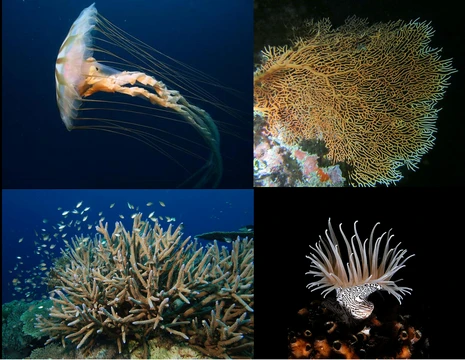
Polyp (zoology)
One of two body forms in Cnidaria, often colonial and reef-building.

A polyp is one of two body forms found in the phylum Cnidaria, the other being the medusa. Polyps are roughly cylindrical, elongated at the axis of a vase-shaped body, with a mouth surrounded by a circlet of tentacles at the oral end and a pedal disc or colonial connection at the aboral end. They are simple animals that have not changed significantly for about half a billion years, and they occur in classes Anthozoa, Hydrozoa, Scyphozoa, and Cubozoa, with varying life cycles.
- phylum
- Cnidaria
- body_form
- Polyp (alternate form: medusa)
- classes
- Anthozoa, Hydrozoa, Scyphozoa, Cubozoa
- key_feature
- Cylindrical body with mouth and tentacles, often attached to substrate
- reproduction
- Asexual budding and sexual reproduction (hermaphroditic or gonochoric)
- known_for
- Building coral reefs; simple, ancient body plan
Lore & Background
Polyps are sac-like animals with a body wall of two cell layers: ectoderm and endoderm, separated by a gelatinous mesoglea. The mouth at the upper end is surrounded by tentacles that contain stinging nematocysts used to capture prey such as copepods and fish larvae. The body consists of a column, a base or foot, and a crown of tentacles enclosing the peristome. In some species, excretory pores occur in the foot or at tentacle tips.
Reader's Guide
Polyps are significant as the primary builders of coral reefs, which support vast marine biodiversity. Their simple, ancient structure—unchanged for roughly 500 million years—offers insights into early animal evolution. In class Anthozoa (sea anemones and corals), the individual is always a polyp; in Hydrozoa, polyps alternate with medusae. Scyphozoans and cubozoans also have polyp stages in their life cycles. Polyps reproduce asexually by budding, forming colonies that can become massive, as in reef-building corals. Sexual reproduction often involves synchronized spawning, with cross-fertilization dominant. Threats to polyps include overfishing, pollution, thermal stress, and ocean acidification, with 75% of the world's corals threatened. New diseases linked to changing conditions and agricultural pollutants like profenofos and MEMC cause polyp retraction and biomass loss. Heat stress in Acropora tenuis polyps up-regulates endoplasmic reticulum proteins, varying by age and growth stage.
Did You Know?
- The name 'polyp' was given by René Antoine Ferchault de Réaumur, from its resemblance to an octopus (French: poulpe).
- Polyps have not changed significantly for about half a billion years, per dating of Cambrian sedimentary rock.
- In scyphozoans, the polyp stage (scyphistoma) can produce medusae by strobilation, then regenerate or die.
- Some sea anemones exhibit sexual plasticity, with clones containing both male and female individuals.
Frequently Asked Questions
Who is Polyp (zoology)?
Polyp is one of the two core body plans in the phylum Cnidaria, the other being the medusa. It is a roughly cylindrical, vase-shaped animal with a ring of tentacles around its mouth at the oral end and a pedal disc or colonial anchor at the aboral end.
What are Polyp (zoology)'s powers/role?
Polyps are the sessile, often colonial form that grips a substrate and uses its tentacle ring to snare prey. They show up across all four cnidarian classes—Anthozoa, Hydrozoa, Scyphozoa, and Cubozoa—and are the primary builders of coral reef structures.
How does Polyp (zoology)'s story end?
In many species the polyp stage simply transitions: it asexually buds new polyps or, in certain life cycles, produces a free-swimming medusa. In classes like Anthozoa there is no medusa at all, so the polyp remains the animal's only form for its entire lifespan.
Why is Polyp (zoology) important?
Polyps have kept essentially the same body plan for roughly half a billion years, making them one of the most ancient and stable designs in the animal kingdom. Their colonial, reef-building behavior underpins entire marine ecosystems and supports a vast amount of biodiversity.
What's the difference between Polyp (zoology) and Medusa?
The polyp is the attached, cylindrical form with its mouth oriented upward and its base fixed to a surface, whereas the medusa is the free-swimming, bell-shaped counterpart. Depending on the class, a cnidarian may experience one, both, or neither of these forms over its lifetime.
More in Cnidarians 1-18
Spotted an error? Know more?
This is a living reference — every entry is fact-audited, and reader corrections feed straight into our audit queue. Suggest an edit · See this site's audit record