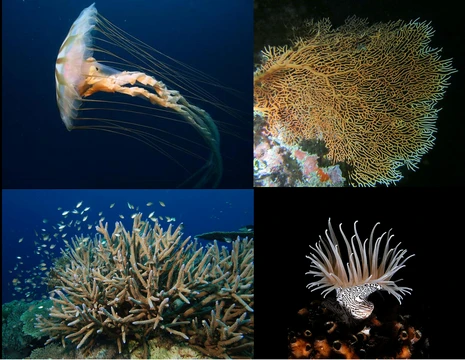
Precious coral
Marine coral valued for its durable red skeleton used in jewelry.

Precious coral, or red coral, is the common name given to a genus of marine corals, Corallium. The distinguishing characteristic of precious corals is their durable and intensely colored red or pink-orange skeleton, which is used for making jewelry. Red corals grow on rocky sea bottom with low sedimentation, typically in dark environments—either in the depths or in dark caverns or crevices.
- scientific_name
- Corallium
- common_species
- C. rubrum (formerly Gorgonia nobilis)
- primary_regions
- Mediterranean Sea, Atlantic near Strait of Gibraltar, Cape Verde Islands, southern Portugal, western Pacific around Japan and Taiwan
- hardness
- 3.5 on Mohs scale
- color_range
- pale pink to deep red
- uses
- jewelry, beads, cabochon cuts
Lore & Background
In the underwater caves of Alghero, Sardinia, it grows at depths from 4 to 35 meters. The same species also occurs at Atlantic sites near the Strait of Gibraltar, the Cape Verde Islands, and off southern Portugal. In common with other Octocorallia, red corals have the shape of small leafless bushes and grow up to a meter in height. Their skeleton is composed of intermeshed spicules of hard calcium carbonate, colored in shades of red by carotenoid pigments. In living specimens, the skeletal branches are overlaid with soft bright red integument, from which numerous retractable white polyps protrude, exhibiting octameric radial symmetry. The origin of coral is explained in Greek mythology by the story of Perseus, who placed Medusa's head on a riverbank, and her blood turned seaweed into red coral. The Romans believed coral could protect children from harm, cure wounds from snakes and scorpions, and diagnose diseases by changing colour.
Reader's Guide
Precious coral has been harvested since antiquity for decorative use, with coral jewelry found in ancient Egyptian and prehistoric European burials. It was especially popular during the Victorian age. At the beginning of the 1st millennium, there was significant trade between the Mediterranean and India, where coral was prized as a substance believed to have sacred properties. Pliny the Elder noted that before the great demand from India, the Gauls used it for ornamenting weapons and helmets. Among the Romans, branches of coral were hung around children's necks as protection, and it had many attributed medicinal virtues. The belief in coral's potency as a charm continued through the Middle Ages and into early 20th century Italy, where it was worn as protection from the evil eye and as a cure for infertility. From the Middle Ages onward, securing rights to coral fisheries off African coasts was a source of rivalry among Mediterranean communities. In Hindu astrology, red coral is associated with the planet Mars and used for pleasing Mars. Among the Yoruba and Bini peoples of West Africa, red coral jewelry signifies high social rank. Intensive fishing, particularly in shallow waters, has damaged the species along the Mediterranean coastline, and fishing and climate change threaten their persistence.
Did You Know?
- The Greek word for coral is 'Gorgeia', as Medusa was one of the three Gorgons.
- Precious coral has hardness 3.5 on the Mohs scale and is usually cut en cabochon or used to make beads.
- In traditional Dutch fishing communities, red coral necklaces were worn by women as part of traditional costumes.
- The three oldest Mediterranean marine protected areas—Banyuls, Carry-le-Rouet and Scandola—host substantial populations of C. rubrum.
Frequently Asked Questions
What is Precious coral?
Precious coral is the common name for the genus Corallium, a group of marine cnidarians recognized for their hard, vividly colored skeletons. The best-known species, C. rubrum, was formerly listed under the name Gorgonia nobilis.
What makes Precious coral stand out among other corals?
Its skeleton is both unusually durable (roughly 3.5 on the Mohs scale) and intensely colored, ranging from pale pink to deep red. This combination of hardness and saturated hue is rare in the cnidarian world and is the reason the material has long been prized for ornamental work.
Where does Precious coral grow and at what depth?
It anchors to rocky, low-sediment seabeds in dark settings such as deep water, crevices, or caverns, spanning depths of about 4 to 1,500 meters. Populations occur in the Mediterranean, the Atlantic near the Strait of Gibraltar and Cape Verde, southern Portugal, and the western Pacific around Japan and Taiwan.
Why is Precious coral used in jewelry?
The skeleton's durability and rich red-to-pink-orange coloration make it ideal for beads, carvings, and other decorative pieces. Because the corals grow slowly in low-light habitats, responsible harvesting practices are a major conservation concern.
How does the red color of Precious coral differ from that of soft corals?
In Corallium, the red pigment is deposited directly into the calcium-carbonate skeleton, so the color remains vivid even after the living tissue is gone. Most soft corals, by contrast, get their coloration from living cells and lose it once the animal dies.
More in Cnidarians 1-18
Spotted an error? Know more?
This is a living reference — every entry is fact-audited, and reader corrections feed straight into our audit queue. Suggest an edit · See this site's audit record